News and Events
Choosing the right project management approach can make or break your project. Two of the most widely used methodologies, Agile and Waterfall, offer very different ways of planning, executing, and delivering work. If you’re preparing for certifications like Project Management Professional (PMP) or working toward Agile credentials such as PMI Agile Certified Practitioner (PMI-ACP), understanding the difference is essential.
In this guide, we break down Agile vs Waterfall in simple, practical terms so you can choose the right approach, and succeed in your projects.
What Is Waterfall Methodology?
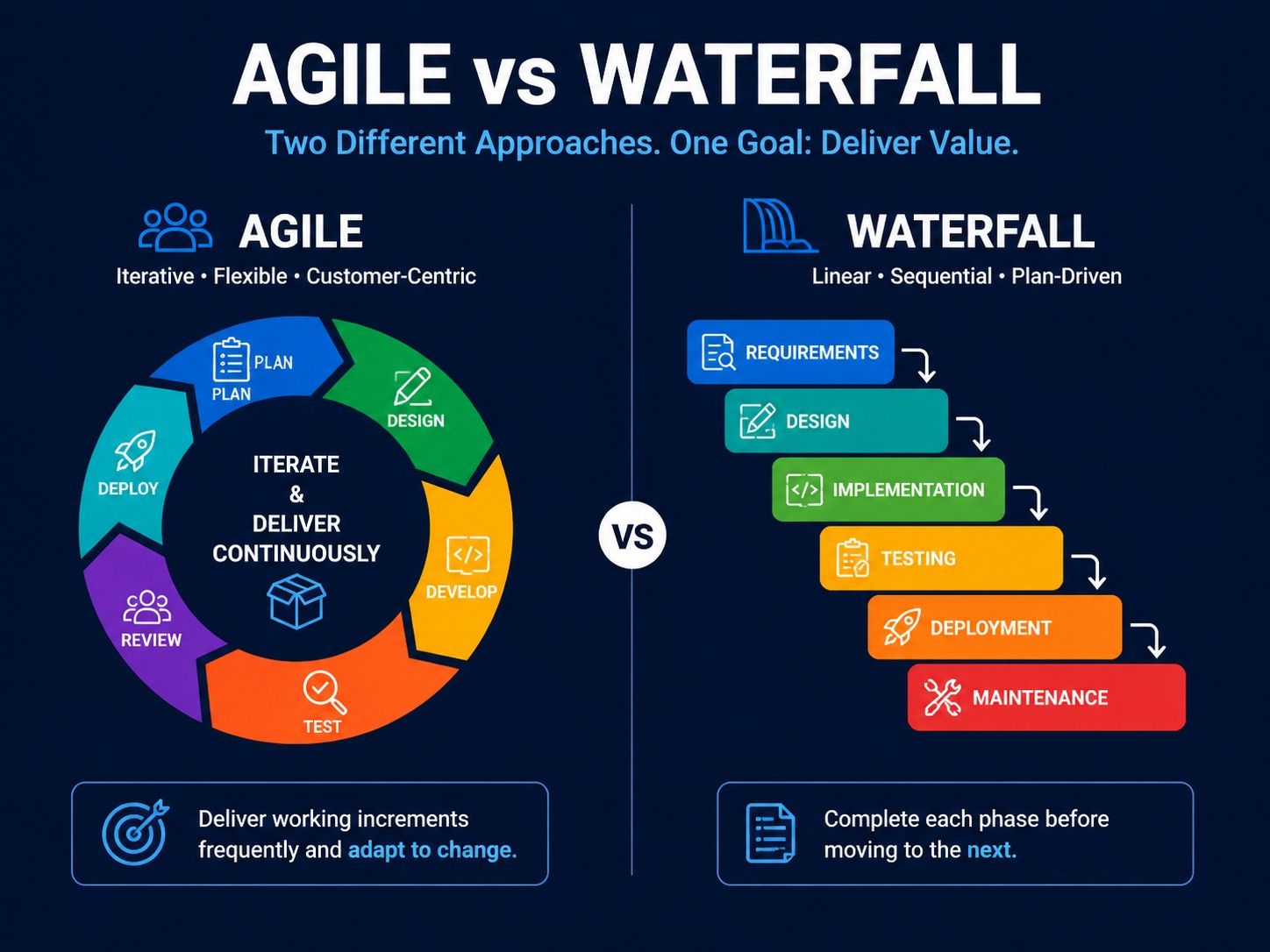
Waterfall is a traditional, linear project management approach where each phase must be completed before the next begins.
Key Characteristics:
- Sequential phases (Requirements → Design → Development → Testing → Deployment)
- Clear documentation and upfront planning
- Changes are difficult once the project starts
- Best suited for predictable, stable projects
When to Use Waterfall:
- Construction or engineering projects
- Government or regulated environments
- Projects with fixed scope and requirements
- Projects with minimal risks and uncertainties
What Is Agile Methodology?
Agile is a flexible, iterative approach that focuses on continuous improvement, customer feedback, and rapid delivery.
Key Characteristics:
- Work is divided into short cycles (sprints)
- Frequent feedback and adaptation
- Emphasis on collaboration and customer value
- Welcomes change, even late in development
Popular Agile Frameworks:
- Scrum
- Kanban
When to Use Agile:
- Software development and tech projects
- Projects with evolving requirements
- Innovation-driven environments
Advantages and Disadvantages
Agile Pros:
- Faster delivery of value
- High customer satisfaction
- Flexibility to adapt to change
Agile Cons:
- Less predictability
- Requires strong team collaboration
- Scope can expand (scope creep)
Waterfall Pros:
- Clear structure and documentation
- Easy to manage and track
- Well-defined scope
Waterfall Cons:
- Inflexible to changes
- Late testing can increase risks
- Customer feedback comes too late
Which One Should You Choose?
The truth is, there is no one-size-fits-all answer.
- Choose Waterfall when requirements are clear and unlikely to change.
- Choose Agile when flexibility, speed, and customer feedback are critical.
Many modern organizations now use a Hybrid approach, combining the structure of Waterfall with the adaptability of Agile.
Why This Matters for Project Managers
As a project manager, mastering both methodologies gives you a competitive edge. Today’s job market values professionals who can adapt their approach based on project needs.
If you’re pursuing certifications like Project Management Professional (PMP) or PMI Agile Certified Practitioner (PMI-ACP), you’ll be tested on both Agile and predictive (Waterfall) concepts, so understanding this comparison is critical for exam success.
Final Thoughts
Both Agile and Waterfall have their place in project management. The best project managers are not tied to one methodology, they are flexible, strategic, and results-driven.
By understanding when and how to apply each approach, you position yourself to deliver successful projects, every time.
Ready to Master Project Management?
At PEMARC, we help professionals like you pass certification exams and advance your career in just 4–8 weeks. Start your journey today and become a globally recognized project management professional.
If you're serious about advancing your project management career, you've likely come across two globally recognized certifications: PMP (Project Management Professional) and PRINCE2 (Projects IN Controlled Environments). Both are highly respected—but they serve different purposes and suit different career paths.
This guide breaks down the key differences to help you choose the right certification for your goals, especially if you're in Kenya or the wider African market.
What Is PMP?
PMP (Project Management Professional) is a globally recognized certification offered by the Project Management Institute (PMI), a USA based organization. It validates that you have the skills, experience, and knowledge to lead and manage projects successfully.
Key Highlights:
- Emphasizes practical experience and decision-making
- Covers People, Process, and Business Environment
- Recognized across industries worldwide
- Requires prior project management experience
What Is PRINCE2?
PRINCE2 is a process-based project management methodology originally developed by the UK government and now managed by AXELOS.
Key Highlights:
- Structured around principles, themes, and processes
- Focuses on clear roles, documentation, and governance
- Widely used in the UK, Europe, and government projects
- No strict experience requirement for Foundation level
PMP vs PRINCE2: Key Difference
1. Approach
- PMP: Focuses on what a project manager should know and do
- PRINCE2: Focuses on how projects should be structured and managed
2. Certification Structure
- PMP: Single, comprehensive certification exam
- PRINCE2: Two levels — Foundation and Practitioner
3. Eligibility Requirements
- PMP: Requires education + project experience + training hours
- PRINCE2:
- Foundation: No experience required
- Practitioner: Requires Foundation certification
4. Global Recognition
- PMP: Highly recognized in USA, Canada, Middle East, Africa, and globally
- PRINCE2: Popular in UK, Europe, and government sectors
5. Exam Style
- PMP: Scenario-based, tests application and critical thinking
- PRINCE2: Knowledge-based and scenario questions focused on methodology understanding
6. Flexibility
- PMP: Covers predictive, agile, and hybrid approaches
- PRINCE2: More structured and process-driven, though PRINCE2 Agile exists
Similarities Between PMP and PRINCE2
Despite differences, both certifications share key strengths:
- Globally respected in project management
- Improve career prospects and earning potential
- Provide structured knowledge to manage projects successfully
- Applicable across multiple industries
Which One Should You Choose?
The right choice depends on your situation:
Choose PMP if you:
- Have project experience
- Want a globally flexible certification
- Prefer a practical, real-world approach
Choose PRINCE2 if you:
- Prefer a structured methodology
- Work in or target UK/EU or government projects
- Are starting with no prior experience
Can You Do Both?
Yes, and many professionals do.
Combining PMP and PRINCE2 gives you:
- Strategic thinking (PMP) + structured execution (PRINCE2)
- A stronger profile for international opportunities
Final Thoughts
There’s no “better” certification—only what fits your career path.
- PMP equips you with skills and adaptability
- PRINCE2 provides structure and governance
Choosing wisely means aligning the certification with your industry, location, and career goals.

If you’re considering a project management certification, one question always comes up: Is PRINCE2 worth it?
The short answer is yes, depending on your career goals, industry, and location.
In this blog post, we break down the career value, salary impact, and real-world relevance of PRINCE2 so you can make an informed decision.
What Is PRINCE2?
PRINCE2 (Projects IN Controlled Environments) is a structured project management methodology developed in the UK and widely used across Europe and government sectors.
It focuses on:
- Clear processes
- Defined roles and responsibilities
- Strong project governance
- Controlled project delivery
Career Value of PRINCE2
1. Strong Global Recognition
PRINCE2 is highly valued in:
- UK
- Europe
- Government and public sector organizations
If you plan to work internationally or with global organizations, PRINCE2 can give you a competitive edge.
2. Ideal for Structured Project Environments
PRINCE2 is best suited for:
- Large organizations
- Government projects
- Highly regulated industries
It provides a clear framework that ensures consistency and accountability.
3. Great for Beginners and Professionals
Unlike some certifications, PRINCE2:
- Has no experience requirement for Foundation level
- Allows beginners to enter project management
- Helps experienced professionals standardize their approach
4. Enhances Credibility
Having PRINCE2 on your CV shows:
- You understand structured project delivery
- You can follow best practices
- You are committed to professional growth
5. Salary Insights: Does PRINCE2 Increase Pay?
Yes, PRINCE2 can positively impact your earning potential.
Average Salary Impact (Global Insight)
- Entry-level project roles: Increased hiring chances
- Mid-level professionals: Salary boost due to certification
- Senior roles: Higher credibility for leadership positions
In many markets, PRINCE2-certified professionals earn more than non-certified peers, especially in structured environments.
Salary Influence Factors
Your salary with PRINCE2 depends on:
- Country/region (higher in UK & Europe)
- Industry (IT, government, finance pay more)
- Experience level
- Combination with other certifications (like PMP or Agile)
PRINCE2 is worth it if you:
- Want to work in UK, Europe, or government sectors
- Prefer a structured and process-based approach
- Are starting a career in project management
- Want to improve your project management skills and earning potential
- Want a recognized certification without strict experience requirements
Final Verdict
So, is PRINCE2 worth it?
Yes — if you want structure, global recognition, and a solid entry into project management.
Even better — when combined with other certifications like PMP or Agile.
Ultimately, the value of PRINCE2 depends on how well it aligns with your career goals, industry, and location.